MakeupVision
FACIAL ANALYSIS · MAY 2024 — MAY 2025
MakeupVision
A virtual-makeup vision pipeline combining face detection, dense landmarks, semantic facial regions, and localized texture transfer.
Problem
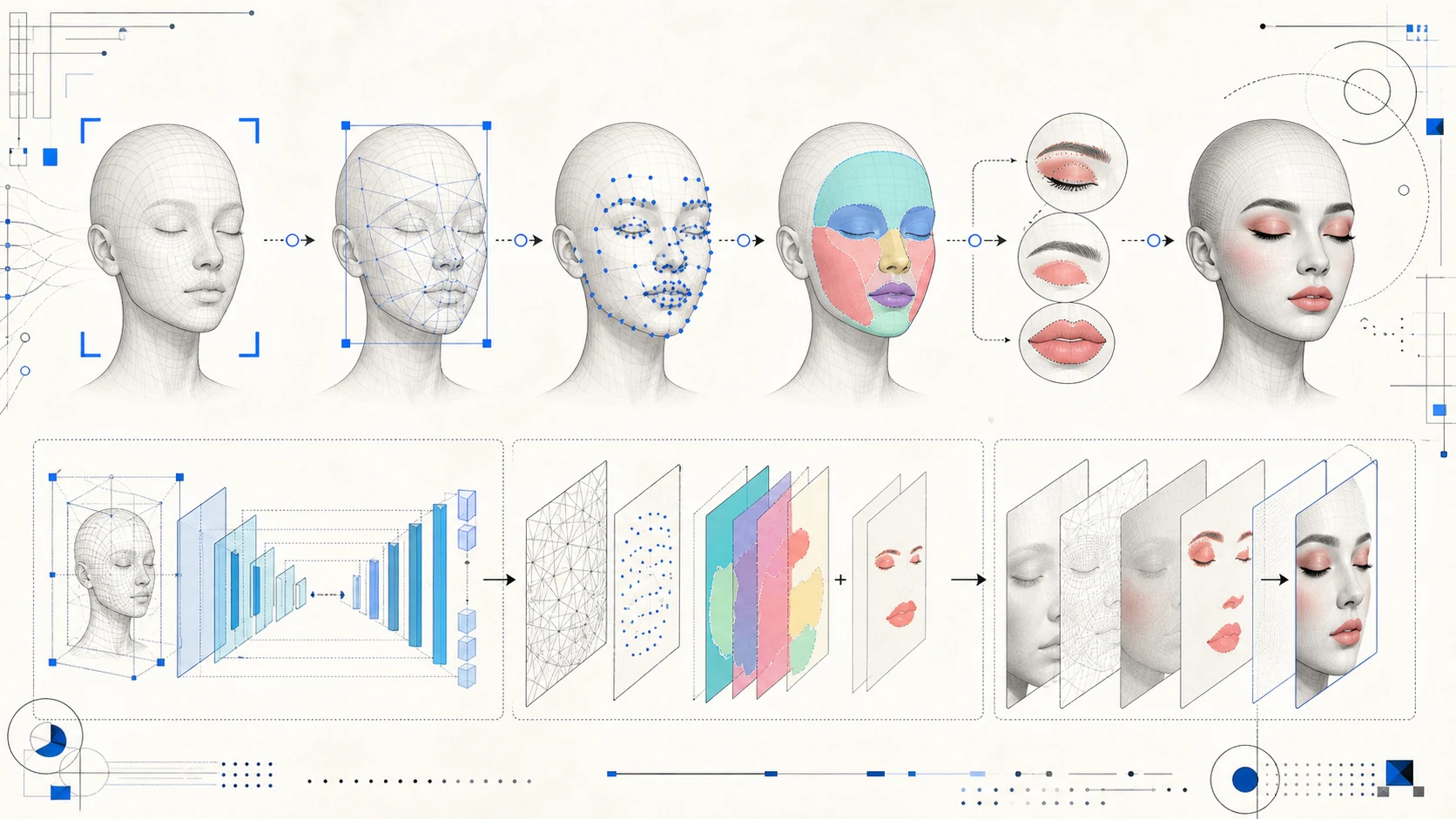
Virtual makeup requires more than global image stylization. The system must locate a face, understand facial geometry, isolate semantic regions, and transfer texture without bleeding across boundaries such as lips, eyelids, brows, and surrounding skin.
Pipeline
Detect
Light-FaceDetector locates the face and defines the working region.
Align
A 106-point landmark heatmap model estimates dense facial geometry.
Parse
Makeup-master semantic segmentation separates facial regions.
Transfer
Region-aware masks guide localized cross-layer texture transfer.
Technical focus
ROI localization
Landmarks and semantic labels provide stable regions of interest for the lips, eyes, and other cosmetic areas.
Mask construction
Lip and eye-region masks constrain each operation to the intended facial structure.
Texture propagation
Cross-layer feature transfer connects source appearance information with spatially aligned target regions.
My contribution
- Led the student innovation project and integrated the main vision modules.
- Implemented ROI localization and region-specific mask generation.
- Worked on cross-layer texture-feature transfer for localized virtual makeup.
- Coordinated project completion and documentation.
VERIFIED OUTCOME
University innovation project · Completion rated Good
No public repository, quantitative benchmark, released dataset, or deployment result is listed because none is verified in the current project record.