Fire & Smoke Detection
OBJECT DETECTION · MAR. 2023 — SEP. 2024
Fire & Smoke Detection
A YOLOv8-based detector designed around diffuse smoke, occluded targets, and small flames.
Problem
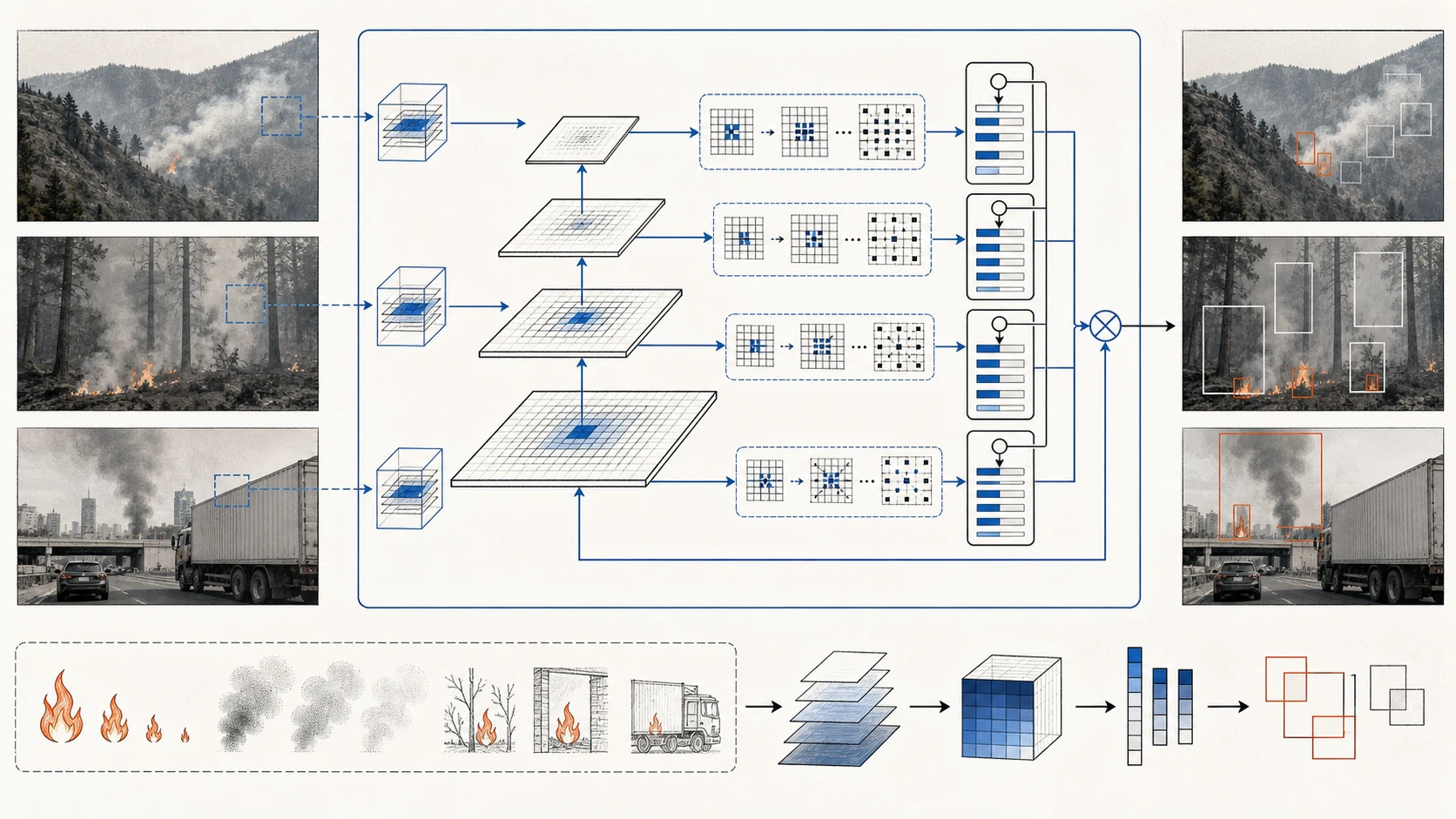
Fire-risk imagery spans very different visual scales. Smoke has diffuse boundaries, flames may occupy only a few pixels, and partial occlusion can hide decisive cues. The project therefore emphasized receptive-field diversity and selective feature fusion rather than treating all feature levels equally.
Architecture
Multi-scale context
Parallel dilated convolution captures local details and broader smoke structure.
Collaborative attention
MCA-style attention strengthens informative channels and spatial regions.
Feature selection
A coordinate-attention-guided hierarchical pyramid filters and fuses features across levels.
Design intuition
Parallel dilation expands context without requiring a single oversized kernel:
Attention weights then modulate hierarchical features before detection. The equation describes the architectural idea and does not add unverified performance claims.
My contribution
- Led the project and organized the detector development around YOLOv8.
- Designed the parallel dilated-convolution, MCA-attention, and coordinate-attention-guided feature-pyramid components.
- Focused the model design on smoke diffusion, partial occlusion, and small-flame detection.
- Constructed and evaluated the project dataset.
VERIFIED RESULT
91.8% mAP on the project dataset
The current record also documents gains of approximately 0.5–0.6 percentage points in occluded-target recall and 1.7 percentage points in small-flame accuracy. No real-world deployment claim is made.