SeamSlicer & AtomicBench
MULTIMODAL VIDEO SLICING · SEP. 2025 — MAY 2026
SeamSlicer & AtomicBench
Speech-aware boundary reasoning for semantically complete, atomic-level automated video trimming.
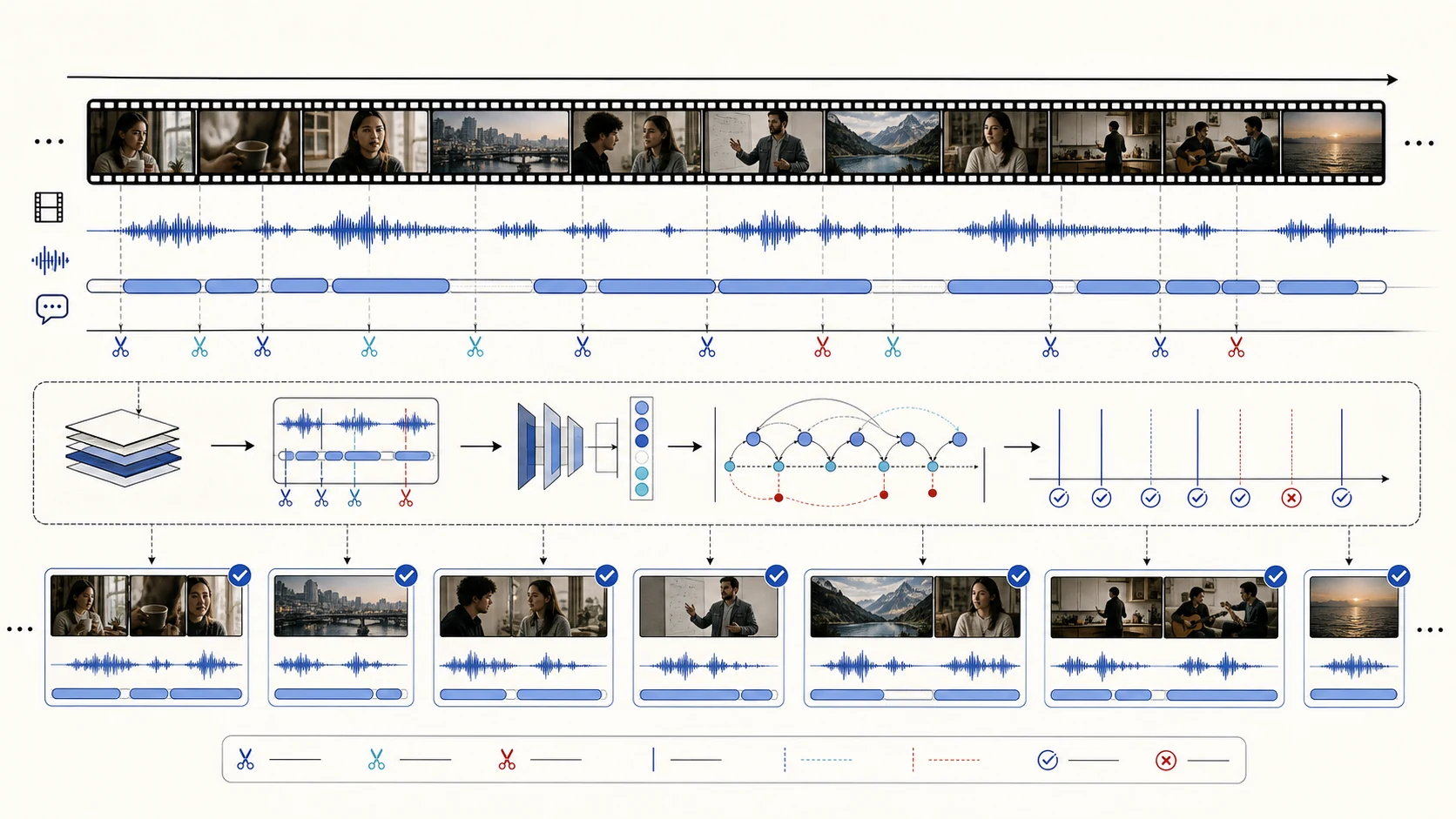
Why atomic slicing?
Fixed-duration cuts can break dialogue, while purely visual boundaries may ignore narration or multi-speaker exchanges. Coarse scene segmentation also leaves unnecessary material inside clips. SeamSlicer treats a useful editing unit as both visually continuous and semantically complete.
The method jointly reasons over visual continuity, narration, dialogue, music, sound effects, on-screen text, and ambient audio.
Three-stage method
Boundary extraction
Combine visual boundary evidence with source-separated audio and timestamped speech intervals.
Visual refinement
Refine candidate cuts using learned temporal features, RGB histogram similarity, and inter-frame similarity.
Length control
Preserve speech-complete segments and subdivide long silent spans using secondary cues.
Boundary reasoning
A visual boundary is accepted only when it does not interrupt a detected speech interval:
For a long silent segment of duration di, uniform subdivision is used only as a fallback: m = ⌈di / τ⌉, with τ = 6 seconds and dsub = di / m.
My contribution
- Participated in candidate-boundary extraction and visual-boundary refinement.
- Contributed to the multi-strategy length-control design.
- Participated in AtomicBench construction, experiments, analysis, and paper preparation.
Verified evaluation
Reported in the accepted paper. AtomicBench contains segments mainly spanning 1–15 seconds; the paper also reports evaluation on BBC and RAI and a human study on trimmed-video quality.
PUBLICATION
Accepted at ACM Multimedia 2026
Speech-Aware Multimodal Video Slicing for Automated Video Trimming
Yandong Liu, Yutao Yang, Shengjiao Dong, Wenqiang Zhang, Xiang Li, Mengli Yu, Zhao-Min Chen, and Lingfeng Yang.