Surveillance Anomaly Detection
METRIC LEARNING · JUL. 2024 — JUN. 2025
Surveillance Anomaly Detection
A Siamese-network-based visual similarity framework for distinguishing fine-grained anomalous behavior under difficult surveillance conditions.
Research question
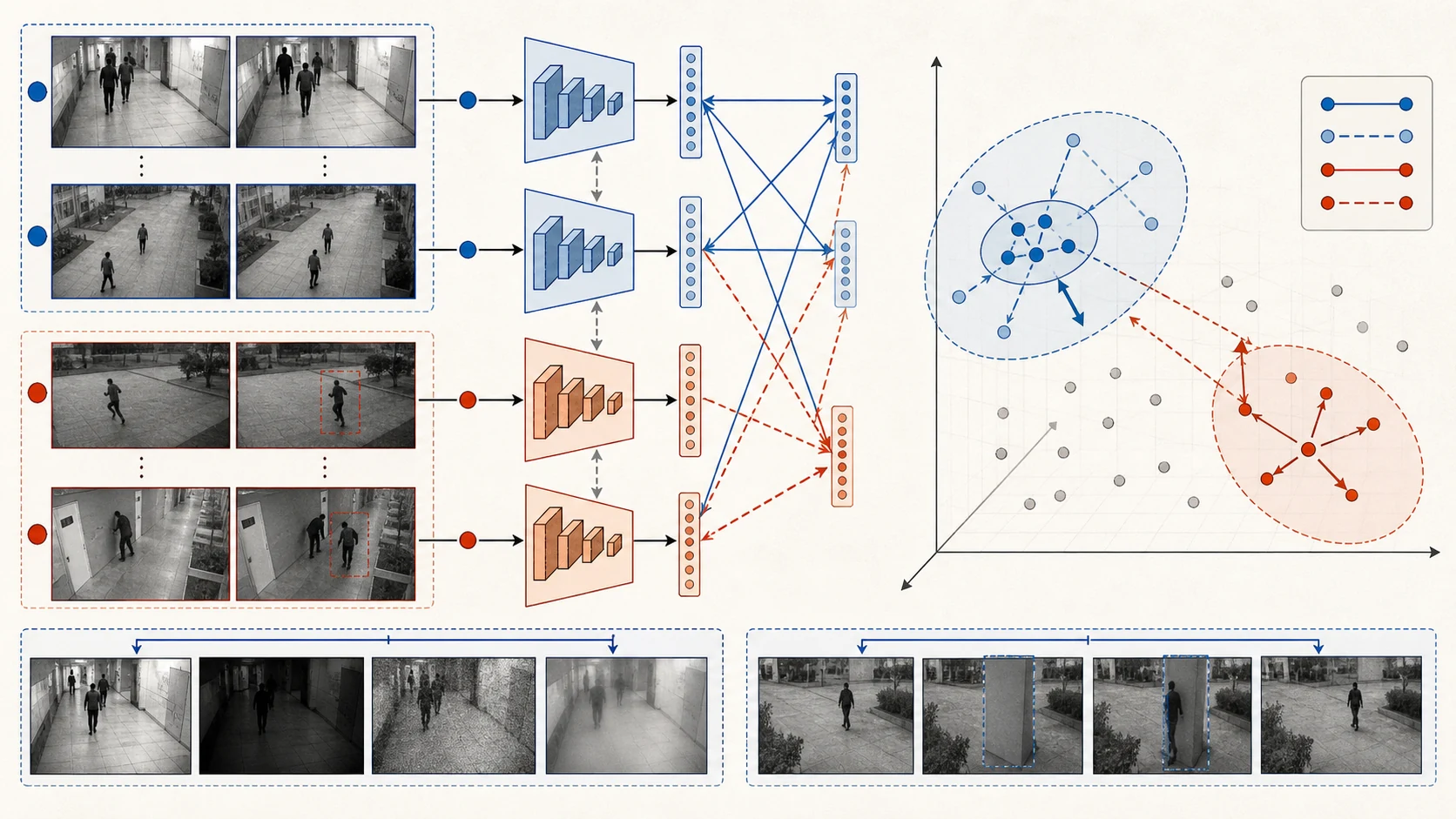
Surveillance anomalies can differ from normal behavior through subtle motion and contextual changes. The project began with a Siamese baseline, which learns a shared representation for paired samples, then explored richer training relationships to improve fine-grained discrimination.
The project title remains centered on the Siamese architecture; the four-branch structure is an extension used within the method, not the name of the project.
Method
Shared representation
Paired branches encode visual observations with shared parameters so that similarity can be measured in a learned feature space.
Four-branch training
The baseline was extended to compare more sample relationships during metric learning, increasing the structure available to the training objective.
Efficient feature learning
The design explored grouped and depthwise-separable convolution, multi-scale feature concatenation, skip connections, and learnable loss weights.
Learning objective
The central idea is to reduce the distance between related samples while enforcing separation from dissimilar observations:
This expression summarizes the learnable weighting of multiple loss terms; the page does not claim a specific numerical improvement because none is verified in the current record.
My contribution
- Led the project and established the Siamese-network baseline.
- Designed the four-branch metric-learning extension and associated training relationships.
- Explored efficient convolution, multi-scale fusion, residual paths, and learnable loss weighting.
- Focused analysis on changes in illumination and partial occlusion.
EVIDENCE BOUNDARY
Research project, not a deployment claim
No public code link, benchmark score, production deployment, or operational impact is listed because those items are not available in the verified project materials.